

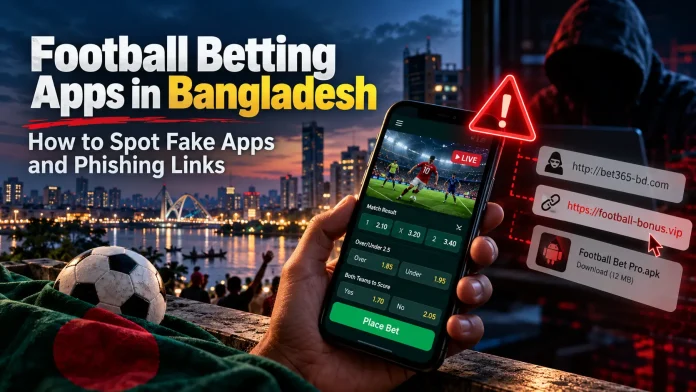
In July 2025, security researchers documented a fake Android app aimed at Bengali-speaking users that copied genuine money transfer services and harvested passwords, PINs and photo IDs. The same tricks return on every big Premier League weekend, because fans searching for a welcome offer are an easy target. Comparing what appears in a random Telegram forward with a known reference, such as the 1xBet promo code BD from Football Whispers, is a simple first filter, since a genuine code is typed in at registration and never requires sending money or a PIN to anyone.
Why big football nights bring a wave of betting scams in Bangladesh
Scammers follow the fixture list. Late European kick-offs keep fans on their phones after midnight, scrolling group chats and quick to tap a link promising a boosted bonus. The July 2026 World Cup final kicked off at 1am Dhaka time, and nights like that produce the mix of excitement and haste phishing campaigns rely on.
The pattern is not limited to betting. The advisories published by BGD e-GOV CIRT, Bangladesh’s government computer incident response team, regularly describe phishing campaigns built on lookalike links. Its January 2025 phishing awareness note listed pages hosted on free services with names designed to mimic official sites, urgent wording that pushes readers to click, and attachments disguised with misleading file extensions. A betting scam uses the same toolkit with a football theme: a fake “match-day bonus” page, a cloned login screen, a file named after a popular app. The common thread is urgency: a message that says an offer expires before kick-off is trying to stop the reader from checking anything.
How fake betting apps are built and spread
Most fake apps never appear in an official store. They are distributed as APK files through social media posts, messaging groups and pages that reuse real logos and promotional videos. The July 2025 case is a useful template. According to McAfee’s analysis of the fake money transfer app, the attackers built Bengali-language websites and fake Facebook pages, then pushed users towards a download that asked for a full name, phone number, photo ID, password and a five-digit PIN. One of the servers behind the operation held 297 image files that appeared to be users’ identity documents.
Swap the remittance branding for a betting one and the method works the same way: a convincing registration form, an accepted “deposit”, an invented balance, then silence when a withdrawal is requested. By then the victim has handed over identity documents and, often, mobile wallet details.
Five checks before installing an app or entering a code
1. Read the full web address. A real operator domain does not end in a free hosting suffix or contain extra letters, hyphens or numbers. A link such as “sports-bonus-bd.example-app.net” is a red flag, however professional the page looks. 2. Check where the download comes from. If an app is offered as an APK, find the download link on the operator’s own website, not in a chat group. Keep Google Play Protect switched on, because it scans for potentially harmful apps and warns before installing them. 3. Look at the permissions requested. A betting app has no reason to read SMS messages, control accessibility services or access contacts. An app that asks for these is trying to capture one-time passwords. 4. Never share an OTP or wallet PIN. No legitimate sportsbook support agent asks for them by phone, chat or email. 5. Test the promo code claim. If a “code” requires a payment to a personal mobile wallet number before it can be activated, it is not a code at all.
A practical example: a Facebook message offers a “300% match” if 1,000 taka is sent to a personal number, with the code arriving afterwards. Every element is wrong. Real welcome codes are entered in the registration form, the first deposit goes through the operator’s own payment page, and the bonus appears in the account under published terms.
What a genuine promo code does and what it does not do
Understanding how a real offer works makes fake ones easier to spot. A typical welcome code is linked to the first deposit and carries wagering requirements, meaning the bonus must be bet a set number of times before it can be withdrawn. As a hypothetical example, a 1,000-taka bonus with a 5x wagering requirement means placing 5,000 taka in qualifying bets, often on selections above a minimum price such as 1.40, within a fixed number of days.
Real terms are published on the operator’s own site; a scam offer usually has none. If the numbers sound too generous to need small print, the small print is missing for a reason. Codes also have a narrow job: they change the starting balance, not the odds on any match or the chances of winning a bet.
If an account or mobile wallet has already been exposed
Speed limits the damage. Change the password of the affected account and of any account sharing that password, then uninstall the suspicious app and run a Play Protect scan. If wallet or card details were entered, call the provider’s official hotline immediately to block transactions, and keep screenshots of the messages, links and app screens, since they help both the provider and any report filed with the authorities.
Betting is for adults aged 18 and over, and it should stay within a budget set before the first match of the weekend, with time and deposit limits used wherever an account offers them. The safest habit is also the dullest one: open the operator’s address manually, check the code against a source already trusted, and treat any message that pushes for a payment before kick-off as an attack until proven otherwise.